

I couldn’t help but wonder: When Maya negotiated to keep her rent at $1,275 instead of accepting $1,500, was she just saving $225 a month? Or was she negotiating her daughters’ futures?
Three weeks before Maya started the rent negotiation with her landlord, she sat at her kitchen table at 11 PM doing different math.
Not rent math this time. Future math.
Her daughters—Zara, 8, and Amara, 5—were asleep in the bedroom they shared. Maya had her laptop open to something called the Opportunity Atlas, a website she’d found while researching her neighborhood for the rent negotiation.
She typed in her address. Then she typed in addresses for apartments she could afford if she had to move.
The numbers that appeared on the screen weren’t about rent. They were about the rest of her daughters’ lives.
The Sec. 8 Choice Everyone Thinks Is Simple
When Maya received her Section 8 voucher two years ago, her caseworker explained it simply:
“Your voucher covers up to $1,200 a month for a 2-bedroom. Find an apartment that accepts Section 8, and you’re good to go.”
What her caseworker didn’t explain:
That where Maya chose to use her voucher would determine:
Where Zara and Amara went to school
Who their friends would be
What opportunities they’d see around them
How much money they’d likely earn as adults
Whether they’d need vouchers of their own someday
The Section 8 program calls it “housing choice.” But Maya was beginning to understand it was choosing much more than housing.
The Experiment That Should Change How We Think About Sec. 8
In 1994, the federal government conducted an experiment that most Section 8 recipients have never heard about. They called it “Moving to Opportunity.”
Here’s what they did:
They took 4,600 families in public housing across five cities—Chicago, New York, Baltimore, Boston, and Los Angeles. Families just like Maya’s. Single mothers with children. Living in high-poverty neighborhoods.
They gave them Section 8 vouchers. But with one requirement:
They could only use them in neighborhoods where less than 10% of residents lived below the poverty line.
Then researchers watched those families for years. Decades, actually.
The adults who moved? Better mental health. Better physical health. But their economic outcomes—their jobs, their income—largely stayed the same. The adults were already formed.
But the children.
The children who moved before age 13 told a completely different story.
What Harvard Discovered - That Every Sec. 8 Parent Should Know
Harvard economist Raj Chetty and his team went back to that data with one question:
Does the neighborhood where a child grows up predict their economic future?
The answer: Yes. Emphatically, definitively, quantifiably yes.
Children who moved to better neighborhoods before age 13:
Attended college at significantly higher rates
Earned approximately $302,000 more over their lifetimes
Had lower incarceration rates
Were less likely to become single parents themselves
Lived in better neighborhoods as adults
Three hundred and two thousand dollars.
Let that number sit for a minute.
That’s not the difference between a nice neighborhood and a struggling one. That’s the difference between Zara and Amara potentially needing Section 8 vouchers of their own versus owning their own homes.
That’s generational wealth versus generational poverty.
And it was determined by where Maya chose to use her voucher.
Maya’s Late - Night Discovery
Back at her kitchen table, Maya stared at the Opportunity Atlas,.
She typed in her current address—the apartment she’d just negotiated to keep at $1,275.
Average household income for children who grew up in her neighborhood: $44,000
She typed in the address of the cheaper apartment she’d found during her search—$950/month, would leave her with more cash each month. Different neighborhood, about 4 miles away.
Average household income for children who grew up there: $28,000
Difference: $16,000 per year. Over a 40-year career: $640,000.
She typed in addresses in the neighborhoods she couldn’t afford even with the voucher—the ones where landlords wanted $1,600, $1,800, $2,000 for a 2-bedroom.
Average household income: $62,000-$78,000.
Maya sat back. Her hands were shaking.
She hadn’t just been negotiating rent. She’d been negotiating Zara and Amara’s statistical futures.
The Numbers Behind the Neighborhoods
The Opportunity Atlas tracks five key outcomes for children who grow up in each neighborhood:
1. Incarceration Rates
In Maya’s current neighborhood: 4.2% of boys who grew up here are incarcerated as adults.
In the cheaper neighborhood she’d considered: 8.7%.
In the neighborhoods she couldn’t afford: 1.1%.
2. College Attendance Rates
Maya’s neighborhood: 38% attend college.
The cheaper alternative: 22%.
The unaffordable neighborhoods: 71%.
3. Future Earnings
We already saw these numbers. $44,000 vs. $28,000 vs. $62,000+.
4. Marriage Rates
Maya’s neighborhood: 41% are married at age 30.
Cheaper alternative: 28%.
Expensive neighborhoods: 64%.
5. Where They Live as Adults
Children who grew up in Maya’s neighborhood: 68% live in similar or worse neighborhoods as adults.
The cheaper alternative: 81%.
Better neighborhoods: 43%.
Maya realized: The children in poorer neighborhoods don’t just earn less. They’re more likely to need the same help their parents needed.
The cycle perpetuates by zip code.
Why Some Families Don’t Move - It’s Not What You Think
Here’s what the research also revealed: Families don’t prefer to stay in low-opportunity neighborhoods.
“Well, if it’s that important, why don’t Section 8 families just move to better neighborhoods?”
Because of barriers most people never think about:
Barrier 1: Landlord Discrimination
“We don’t accept Section 8” is perfectly legal to say in many states.
Even where it’s illegal, landlords find ways:
“Sorry, just rented it” (it wasn’t)
Credit requirements that disqualify voucher holders
Application fees that add up when you’re denied repeatedly
“First month, last month, AND two months security” (legal, but impossible)
Barrier 2: Search Costs
Try apartment hunting in a neighborhood you don’t know:
No car (most Maya could afford required bus transfers)
Taking time off work (which she couldn’t afford)
Application fees ($50-75 each × 10 applications = $500-750)
Breaking current lease (often required to even look)
Barrier 3: Information Gap
Maya’s caseworker told her the rent limit. She didn’t tell her:
Which neighborhoods had the highest opportunity scores
Where the best schools were
Which areas were transitioning (getting better vs. worse)
How to interpret the data that could change her daughters’ lives
Barrier 4: The Urgency Trap
Vouchers expire. Housing authorities give you 60-120 days to find a place.
When you’re facing homelessness in 90 days, you take the first apartment that says yes.
You don’t have time to research your children’s statistical futures.
The Seattle Solution - Proof This Can Change
In Seattle and King County, researchers partnered with the local housing authority to try something different.
They didn’t just hand out vouchers and wish families luck.
They provided:
Housing counselors who knew which neighborhoods had high opportunity scores
Help with apartment searches (actual staff time, not just a phone number)
Financial assistance for application fees and moving costs
Landlord recruitment in high-opportunity areas
Mediators when landlords hesitated
The result:
A significant increase in families moving to high-opportunity neighborhoods.
Not because families suddenly wanted better for their children—they always wanted better.
Because the barriers were removed.
What Maya Realized at 11 PM
Maya looked at Zara’s math homework on the table. Fractions. The teacher had written “Great work!” in purple pen.
She thought about the numbers on her screen.
If she’d moved to save money:
$950/month instead of $1,275
She’d save $325/month = $3,900/year
Over 10 years: $39,000
But Zara and Amara would statistically:
Earn $16,000/year less (each)
$32,000/year less combined
Over 40-year careers: $1,280,000 less (combined)
The “cheap” apartment would cost her daughters $1.28 million.
The Real Reason Maya Fought to Stay
When Maya walked into her landlord’s office three weeks later to negotiate her rent, everyone thought she was negotiating about money.
Her caseworker thought: “She’s trying to avoid paying $300/month out of pocket.”
Her mother thought: “She doesn’t want to move because it’s hard with two kids.”
Her friends thought: “She’s just being stubborn about an extra $75 a week.”
But Maya knew the truth:
She was negotiating for Zara’s college attendance rate to be 38% instead of 22%.
She was negotiating for Amara’s future earnings to be $44,000 instead of $28,000.
She was negotiating for her daughters’ children to not need vouchers.
She was negotiating generational wealth versus generational poverty.
When her landlord said “$1,500 or you need to find a new place,” Maya didn’t just see a number.
She saw:
Zara and Amara changing schools
Moving to a neighborhood with double the incarceration rate
Losing the network of neighbors who watched her girls after school
Resetting their entire support system
Cutting their statistical lifetime earnings by $640,000 each
So she showed him the data. The Fair Market Rent numbers. The comparable apartments. Her value as a tenant.
And she refused to accept that her daughters’ futures were already decided by their address.
The Numbers Are Available to Everyone
The Opportunity Atlas is public. Free. You can look up any address in America.
Visit: opportunityatlas.org
Type in:
Where you live now
Where you’re thinking of moving
Where you grew up
Where your children live
See the data. The five key outcomes:
Incarceration rates
College attendance
Future earnings
Marriage patterns
Where they live as adults
Then make informed choices.
Because here’s what Maya learned:
Section 8 isn’t just housing assistance. It’s an economic mobility tool—if you know how to use it.
The Uncomfortable Truth About Housing Policy
The Moving to Opportunity experiment proved something most policymakers don’t want to acknowledge:
Giving people vouchers isn’t enough.
Not if we:
Don’t tell them about the Opportunity Atlas
Don’t help them overcome search barriers
Don’t address landlord discrimination
Don’t explain that their housing choice determines their children’s futures
We hand out vouchers and tell families: “Find an apartment that accepts Section 8.”
We should be saying: “Find an apartment in a neighborhood that gives your children a statistical shot at a different life.”
The difference is generational wealth versus generational poverty.
And we’re letting that difference happen by zip code.
What Maya’s Story Means for Sec. 8 Policy
Maya’s rent negotiation saved her $5,400 over two years.
But her decision to fight to stay in her neighborhood might save Zara and Amara $1.28 million over their lifetimes.
That’s the real math of opportunity.
Housing authorities should:
Provide Opportunity Atlas data to every voucher recipient
Offer counseling on neighborhood choice (not just rent limits)
Help families access high-opportunity areas (Seattle model)
Track not just housing stability but economic mobility outcomes
Measure success by where children end up, not just where families get housed
Because Section 8 vouchers are expensive—but generational poverty is more expensive.
Maya Today
Maya still lives in her apartment. Rent: $1,275. Well within her voucher.
Zara is thriving in 3rd grade. Amara just started kindergarten. Same school. Same friends. Same neighborhood.
But Maya is doing something else now:
She’s telling other Section 8 recipients about the Opportunity Atlas .
She’s helping them understand that “housing choice” means choosing their children’s statistical futures.
She’s sharing her negotiation story so other families know:
You have more power than you think.
Landlords need good tenants more than you think.
And where you choose to live determines more than you ever thought possible.
The Questions We Should Be Asking
For parents with vouchers:
Have you looked up your neighborhood on the Opportunity Atlas?
Do you know the opportunity scores for areas where your voucher would work?
Are you making housing decisions with full information about your children’s futures?
For housing authorities:
Are you providing Opportunity Atlas data to voucher recipients?
Are you measuring economic mobility outcomes, not just housing stability?
Are you removing barriers to high-opportunity neighborhoods (Seattle model)?
For landlords:
Do you understand that accepting Section 8 in high-opportunity areas literally changes children’s lives?
Have you considered the social impact of “we don’t accept Section 8”?
For all of us:
Are we okay with children’s futures being determined by their parents’ zip codes?
Are we willing to acknowledge that “housing choice” isn’t really a choice without information and support?
What would it take to actually break the cycle?
The Real Negotiation
When Maya sat across from her landlord negotiating rent, she used the PREP Framework™:
Position: Assessed her value as a tenant Research: Gathered Fair Market Rent data and comparables Exchange: Had a strategic conversation Propose: Offered three solutions
She saved $2,700 over two years.
But the bigger negotiation happened when she first got her voucher two years ago.
The negotiation no one told her she was having:
“Where will you use this voucher? Because that choice will determine your daughters’ statistical futures.”
She didn’t know about the Opportunity Atlas then. She got lucky—chose a neighborhood that happened to have decent opportunity scores.
But luck shouldn’t determine generational wealth.
Information should. Choice should. Agency should.
Everything’s Negotiable. Even Destiny.
So yes, Maya negotiated her rent.
But more importantly, she negotiated:
Which schools her daughters attend
What opportunities they see around them
Who their peers will be
What seems possible to them
What they’ll statistically earn as adults
Whether they’ll need vouchers of their own
She negotiated the invisible forces that try to determine futures by zip code.
Because here’s what the Opportunity Atlas taught her:
Geography isn’t destiny. But it’s a powerful force.
And if everything’s negotiable, then so is where that force pushes our children.
Your Next Step
If you have a Section 8 voucher:
Visit opportunityatlas.org RIGHT NOW
Type in your current address
Look at the five outcomes for children who grew up there
Type in addresses of other neighborhoods where your voucher would work
Compare the data
Make your housing choices with your children’s statistical futures in mind
If you’re a housing authority caseworker:
Add Opportunity Atlas training to your voucher orientation
Provide printed maps showing opportunity scores by neighborhood
Adopt the Seattle model: active support for high-opportunity moves
Measure economic mobility outcomes, not just housing stability
If you’re a landlord:
Consider accepting Section 8 in high-opportunity areas
Understand you’re not just providing housing—you’re providing opportunity
“We don’t accept Section 8” isn’t just policy—it’s a choice about other people’s children’s futures
Learn More
Essential Resources:
Opportunity Atlas: opportunityatlas.org - Look up ANY address in America
Moving to Opportunity Research: nber.org/mtopublic - The original experiment
Opportunity Insights: opportunityinsights.org - Raj Chetty’s ongoing research
HUD Housing Choice Voucher Program: hud.gov/helping-americans/housing-choice-vouchers
Required Reading:
Our Kids by Robert Putnam - The growing opportunity gap
The Color of Law by Richard Rothstein - How government created segregation
Evicted by Matthew Desmond - The impact of housing instability
For Housing Authorities:
Seattle/King County Housing Authority’s Creating Moves to Opportunity program model
The Bottom Line
Section 8 vouchers are powerful economic mobility tools.
But only if recipients know they’re choosing more than housing.
Only if barriers to high-opportunity neighborhoods are removed.
Only if we acknowledge that where children grow up determines their statistical futures.
Maya’s $225/month rent negotiation might be worth $1.28 million to her daughters.
That’s why everything’s negotiable. Even the zip codes that try to determine destiny.
Learn Maya’s complete rent negotiation story and get the PREP Framework™ in “The Offer: Everything’s Negotiable™” - Available now with code MAYA2026 (free through January 31st)
Current Market Context
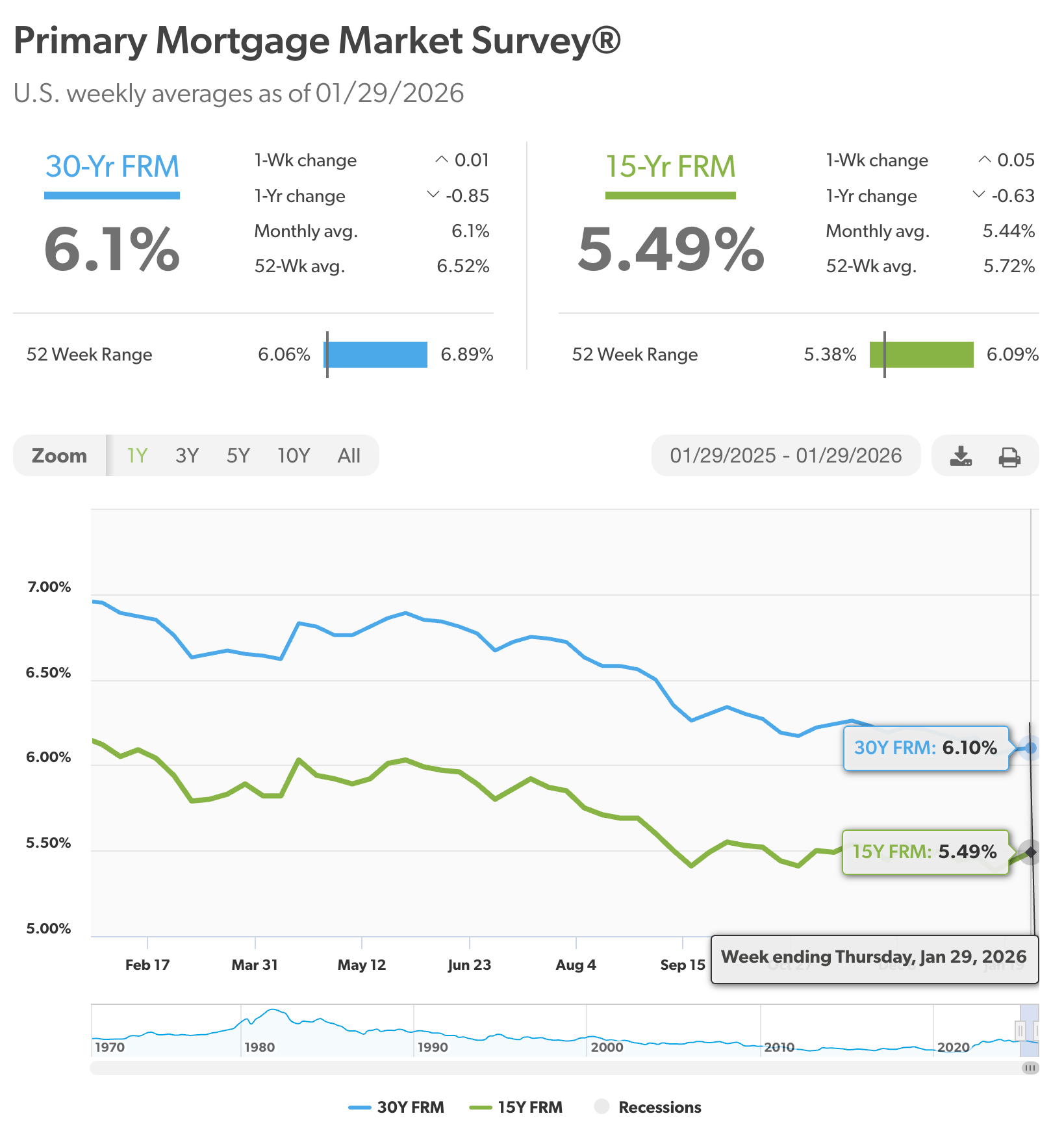
Mortgage Rates (weekly averages as of 01/29/2026)
30-Year Fixed: 6.10% ↑
15-Year Fixed: 5.49% ↑
What Happened This Week:
Rates ticked up slightly (1 basis point on 30-year, 5 basis points on 15-year) but remain near their lowest levels in three years. The minimal increase reflects market stability as economic data shows continued resilience.
Market Impact:
Despite the uptick, rates are still dramatically lower than last year—6.10% vs 6.95% for 30-year fixed. This 85 basis point difference has brought buyers back: purchase applications are steadily increasing year-over-year, and refinance activity is surging as homeowners who bought in 2023-2024 take advantage of the drop.
Strong income growth combined with lower rates has improved affordability significantly, creating the best buying window in three years.
Action Items:
→ Buyers: Excellent time to act—rates remain at 3-year lows despite the slight uptick. Spring inventory is increasing. Multiple lender quotes can save thousands.
→ Refinancing: If you bought when rates were 7%+, you could save $150-250/month by refinancing to 6.10%. Worth running numbers with 2-3 lenders.
→ Renters: Lower rates make homeownership programs more accessible. If you’re saving like Maya, explore first-time buyer programs now.
Up Next: Sarah’s Story
Everyone told Sarah she couldn’t win a bidding war with only 3.5% down.
She lost her first offer—even bid $400,000 and still lost to a cash buyer who paid $380,000.
Three weeks later? Sarah won her second bidding war. Paid $398,000 (less than her first losing offer). Beat out 3 other offers, including cash buyers.
How? She stopped competing on price and started competing on terms.
Sarah discovered what sellers actually want isn’t always the highest offer.
Subscribe so you don’t miss it.
Launching Soon - The Offer: Everything’s Negotiable™
Click for early access - you’ll be first to know when we launch, plus early bird pricing and exclusive bonuses.

Eve Moss
Founder, Women + Real Estate™
womenplusrealestate.com
Subscribe below to get regular newsletters in your inbox.
Women + Real Estate™ - Because housing choice should be informed choice, and every child deserves a statistical shot at opportunity, regardless of their parents’ voucher status.
Thank you for being here. Everything’s negotiable.
About the Women + Real Estate™ Opportunity Fund - 10% of all product sales fund scholarships and micro-grants for women in housing transitions. When you purchase any product, you’re helping another woman negotiate from strength.
Disclaimer: The stories shared in this newsletter are based on real negotiation scenarios but are presented as composite characters with changed names and details to protect privacy. Content is for educational purposes only and does not constitute legal, financial, or professional advice. Real estate laws and regulations vary by location. Consult qualified professionals before making real estate decisions. Section 8 policies, commission structures, and contract terms differ by jurisdiction. What worked in these examples may not apply in your situation. Past results do not guarantee future outcomes.
Legal Notice: The PREP Framework™ and Everything’s Negotiable™ are trademarks of Chavah Media Ltd. | Women + Real Estate. All rights reserved.
© 2026 Chavah Media Ltd. | Women + Real Estate™ . All rights reserved.